
A Tale of Two Anticholinergics: Nutmeg and Jimson Weed
By Jennifer Colby, PhD, DABCC (CC, TC), F-ABFT
Published in the March 2024 issue of Clinical & Forensic Toxicology News
The Therapeutic Drug Management (TDM) and Toxicology Division of ADLM is excited to announce a partnership with CFTN on an initiative to bring the Division’s toxin library to CFTN’s readership! The toxin library is a digital resource that happens to be one of the most frequently visited ADLM web pages. At present, the library contains entries for 12 naturally occurring toxins, with plenty of room to grow. As part of the partnership with CFTN, the Division has begun the process of updating the existing toxin library content and adding entries for new toxins. Each upcoming issue of CFTN will include an article on a featured toxin, authored or revised by a member of the Division. If you are interested in volunteering to assist with this project, please contact the TDM/ Toxicology Division. In this first feature article, we present revised entries for two toxins that may cause an anticholinergic toxidrome (the classic red as a beet, dry as a bone, blind as a bat, and mad as a hatter syndrome).
Nutmeg is obtained from the seeds of Myristica fragrans, an evergreen tree native to the South Pacific islands (Figure 1). Nutmeg is commonly available at supermarkets across the globe and may be purchased as an intact seed or as a powder. Nutmeg has a long history of use as a spice for food and drinks and was once the subject of significant trade. Interestingly, nutmeg has long been known to cause physiologic effects when ingested in large amounts. Reports of nutmeg intoxications date back approximately 400 years (1). More recently, nutmeg intoxication has been the focus of a viral social media trend wherein willing participants record themselves ingesting nutmeg. The main participants in this so-called “Nutmeg Challenge” have been teenagers, some of whom ingested enough nutmeg to need medical care (2).
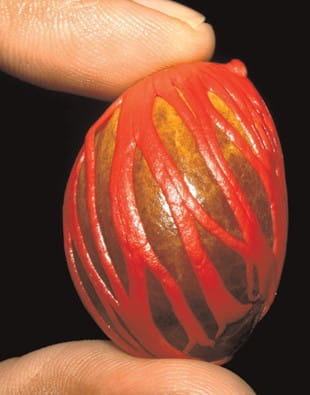
Figure 1. Red aril surrounding a nutmeg seed (Myristica fragrans). The nutmeg seed and the aril, which is also known as mace, are both used as spices. Reproduced with permission from AntanO/Wikimedia Commons/ CC-BY-SA-3.0.
Nutmeg contains volatile terpenes and aromatic ethers and has been used to treat dyspepsia, musculoskeletal disorders, and arthritis. Myristicin, elemicin, and safrole are three of the pharmacologically active compounds found in nutmeg. Myristicin and elemicin produce metabolites with amphetamine-like structures (3). Nutmeg ingestions can produce anticholinergic symptoms as well as altered mental status and hallucinations.
Nutmeg intoxication typically requires 5 to 20 grams (1 to 4 teaspoons) of ground nutmeg, significantly more than required for cooking. In intentional intoxications, nutmeg is often administered as a tea. A typical supermarket container of nutmeg holds approximately 60 to 80 grams of ground nutmeg, which is sufficient for multiple intoxications. The low cost and ease of acquisition makes nutmeg an appealing choice for young people looking for “natural highs.”
The onset of symptoms occurs within 3 to 6 hours and lasts for 12 to 24 hours. Symptoms typically resolve within 48 hours and most patients make a full recovery (3). Toxic symptoms are doserelated and primarily anticholinergic, including dry mouth, GI upset, flushing, palpitations, agitation, blurred vision, miosis, hypotension, hypothermia, hallucinations, as well as coma and death. The scientific literature contains two reports of death attributed to nutmeg ingestion; in one case an 8-year-old boy ingested approximately 14 grams of nutmeg, and the other involves a 55-year-old woman who ingested an unknown amount of nutmeg (3). Treatment for nutmeg intoxication is generally supportive in nature; there is no specific antidote (3). Physostigmine is not typically recommended after a nutmeg exposure.
Detection of nutmeg-related compounds is not currently available except through laboratory developed tests. Using chromatography and mass spectrometric methods, metabolites of elemicin, myristicin, and safrole have been detected in the blood and urine of patients who ingested nutmeg (1, 4). Gas chromatography and liquid chromatography have both been used, as have nominal mass and high-resolution mass spectrometers.
Jimson weed (Datura stramonium) is one of the 3,000-plus members of the Solanaceae family, one of the largest families in the plant kingdom. Included in this family are edible crop species such as the potato, eggplant, and tomato (5). The family also includes ornamental plants including the Datura genus, which produces trumpet-like flowers in a variety of colors. There are more than a dozen species of this naturalized Asian plant that grow in many regions of the world. The plant has stout, much-branched, leafy stems from 2 to 5 feet high and large, smooth, thin, wavy, toothed leaves from 3 to 8 inches long. The flowers, which appear from May to September, are white, funnel-shaped, about 3 inches long, and have a pronounced odor. The plants produce prickly seed pods filled with small brown seeds that are colloquially known as “thorn apples” (Figure 2) (6).
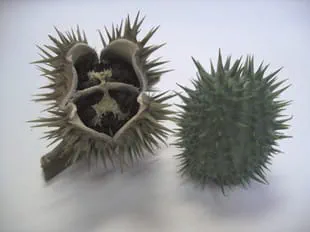
Figure 2. “Thorn apple” (Datura stramonium) seedpods. Mature seedpod (L) and immature seedpod (R). Reproduced with permission from Corin Royal Drummond/ Wikimedia Commons/CC-BY-SA-3.0.
Jimson weed has a lengthy history as a medicinal plant, with use recorded as early as the 1500s, but is also frequently associated with accidental and intentional intoxications (5). In the Americas, the first reported account of accidental jimson weed poisoning occurred in 1676 in Jamestown, which gave rise to the common name of jimson weed (5). A recent large-scale poisoning outbreak occurred in Uganda due to accidental contamination of the food supply during harvesting; home gardeners occasionally make similar mistakes (7). Intentional misuse by eating seeds, drinking tea, or smoking cigarettes made of jimson weed is common. The scientific literature contains a plethora of case reports detailing the intentional use of jimson weed by teenagers or other younger people in an effort to experience its psychoactive effects.
Like many Datura species, jimson weed contains alkaloids that possess strong anticholinergic and antimuscarinic properties. These compounds include atropine (d,l hyoscyamine), hyoscine, and scopolamine (l-hyoscine) that act as competitive antagonists to acetylcholine at muscarinic acetylcholine receptors (6). Physiological effects associated with muscarinic receptor stimulation include an impact on sweating, salivation, and smooth muscle tone. As tertiary amines, jimson weed alkaloids also have central nervous system absorption and result in a central anticholinergic syndrome of acute psychosis and delirium. All parts of the jimson weed plant contain potentially toxic compounds; the alkaloids can be ingested, smoked, or topically absorbed from roots, leaves, stems, and flowers. The exact concentration of the alkaloids varies with species, cultivation, environment, temperature, moisture, storage, flower status, and age of the plant. The highest concentration of atropine typically occurs in the seeds (6).
Medicinal uses of the alkaloids are varied. In traditional Chinese medicine, alkaloids have been used to treat asthma, chronic bronchitis, pain, and flu symptoms. Atropine has been used in ophthalmic solutions and is also available in oral and intravenous formulations for use in the treatment of bradycardia and first-degree heart block. Atropine is also an important antidote in organophosphate insecticide poisoning, where it reduces the effects of excess acetylcholine at muscarinic receptors. Scopolamine is used to treat motion sickness and as a pre-anesthetic medication, and is available in a variety of formulations.
Ingestion of jimson weed often results in anticholinergic toxicity as the alkaloids are easily absorbed from the GI tract. The effects manifest as classic anticholinergic poisoning with symptoms initially observed within 30 to 60 minutes. Symptoms may continue for 24 to 48 hours if left untreated. Metabolism of the alkaloids occurs in the liver by hydrolysis that eliminates approximately half of the dose. The remainder is excreted unchanged in the urine.
Fatalities due to jimson weed are relatively rare, making up less than 0.1% of fatal poisonings reported to poison control centers in the United States (8). Physostigmine may be used clinically to reverse the anticholinergic symptoms but many cases are managed supportively. Adolescents account for nearly 50% of the jimson weed exposures reported to United States poison control centers; of these, the vast majority of exposures were intentional (8).
Detection of jimson weed alkaloids in human biospecimens is not currently available except through laboratory-developed tests. Using chromatography and mass spectrometric methods, atropine and scopolamine have been detected in a variety of samples, including human hair, blood, and urine (7). Testing for these compounds is available at reference laboratories in the United States.
Jennifer Colby, PhD, DABCC (CC, TC), F-ABFT is the Scientific Director at Premier Biotech in Minneapolis, MN, and the current Chair of ADLM’s TDM and Toxicology Division.
The author has nothing to disclose.
Nutmeg is obtained from the fruit (seeds) of Myristica fragrans, an evergreen tree native to the South Pacific islands, and is commonly used as a cooking spice. Nutmeg contains volatile terpenes and aromatic ethers and has been used to treat dyspepsia, musculoskeletal disorders and arthritis. Myristicin (A) and elemicin (B) are two of many pharmacologically-active chemical compounds found in nutmeg and have similar chemical structures to amphetamines and mescaline, respectively. Inebriant effects of nutmeg were reported as early as 1576. Nutmeg was an important trade item in the 15th and 16th centuries, and was used by slaves on the ships bringing nutmeg to Europe to precipitate a pleasant, euphoric feeling that relieved their weariness and pain. Nutmeg also became recognized for its ability to induce abortions. Although not a popular street drug today, nutmeg may be abused by those looking to alter consciousness with a readily available, legal substance. Intoxication requires 5-20 grams (1-4 teaspoons) of ground nutmeg, often administered as a tea. Onset of symptoms occurs within 3-6 hours and last for 12-24 hours, often followed by deep sleep. Toxic symptoms are dose-related and primarily anticholinergic, including dry mouth, GI upset, flushing, palpitations, agitation, blurred vision, miosis, hypotension, hypothermia, hallucinations, as well as coma and death. Detection of nutmeg-related compounds by laboratory testing is not readily available. Activated charcoal may be used to prevent absorption of recent ingestions, but clinical management is otherwise supportive.
Jimson weed is one of the over 3,000 members of the Solanaceae family many of which contain the alkaloids atropine (dl-hyoscamine) and scopolamine (hyoscine). The plant family Solanaceae is one of the largest families in the plant kingdom. Included in this family are edible species such as the potato (Solanum tuberosum L.), eggplant (Solanum melongena L.) and the tomato (Solanum lycopersicum). The family also includes ornamental plants of the genera Brunfelsia, Cestrum, Nicotiana and Datura among many others.
Jimson weed is of the Datura genus (Datura stramonium) which produces trumpet-like flowers in a variety of colors. There are more than a dozen species of this naturalized Asian plant. The plant has stout, much-branched, leafy stems from 2 to 5 feet high and large, smooth, thin, wavy, toothed leaves are from 3 to 8 inches long. The flowers, which appear from May to September, are white, funnel-shaped, about 3 inches long, and have a pronounced odor. The prickly seed pods which follow are about the size of a horse chestnut. When ripe these pods burst open, scattering numerous poisonous black, kidney-shaped seeds.
All parts of the plant are toxic and have been ingested, smoked or topically absorbed. The exact concentration of the alkaloids varies with species cultivation, environment, temperature, moisture and storage. The highest concentration occurs in the seeds with approximately 0.1 mg atropine per seed.
Other members of the Solanaceae family have tropane alkaloids. The Deadly Nightshade (Atropa belladonna) is one of the most famous and hence the name belladonna alkaloids for the anticholinergic tropane alkaloids found in these plants. Information about this plant can be found at http://www.botanical.com. In 1833 atropine was isolated from this plant. Other members of the Datura genus include fastuosa (purple hindu datura) and Toloache (Datura inoxia) from Mexico. Very closely related is the Brugmansia genus which generally are much larger plants than the Datura genius and includes the Angel's Trumpet.
This is a very common weed in fields and waste places almost everywhere in the United States except in the North and West and widely disturbed throughout the world.
The plant has been described throughout history as a toxin famous for its mind altering properties. There are references to it in Homer's Odyssey and Shakespeare plays. In the Americas the most reported account is from 1676 when some of the Jamestown settlers were near death after eating Datura stramonium (hence the name Jamestown weed) and then began using the plant for medicinal purposes, primarily as a sedative. Other Datura species have similar social histories. An extract of Datura metel, sometimes called Hindu Datura, was used as knockout drops to lure virgins into prostitution and then used by prostitutes on their clients. The Roman army in Asia Minor was severely crippled by deaths caused by eating a Datura species. Indians in Columbia used another Datura species for infanticide.
Accidental exposures have been reported by gardeners from ingestions of plant parts mistaken for other herbs. Even accidental exposure during routine gardening chores have resulted in "Gardener's Mydriasis" and "Cornpicker's Pupil". These exposures may result in mydriasis for several days. Intentional misuses by teenagers who eat seeds, drink tea or smoke cigarettes made of Jimson Weed have been reported.
Atropine and scopolamine have long been associated with withchcraft. Various authors have traced the use of these substances to place victims into trans like states. The plants of the datura, nightshade, mandrake and henbane are known as hexing herbs.
The toxins in Jimson Weed are tropane alkaloids which possess strong anticholinergic properties. They include atropine (d,l hyoscyamine) (leaves, roots, seeds), hyoscine (roots), and scopolamine (l-hyoscine). They act as competitive antagonists to acetylcholine at muscarinic receptors and effect sweating, salivation and smooth muscles. As tertiary amines they also have central nervous system absorption and result in a central anticholinergic syndrome of acute psychosis and delirium.
These toxins are easily absorbed from the GI tract. Atropine has a half-life of 4 hours. Metabolism occurs in the liver by hydrolysis which eliminates approximately half of the dose with the remainder excreted unchanged in the urine.
As herbal medications various preparations have been used over the years. Chinese herbal medicines that contain tropane alkaloids have been used to treat asthma, chronic bronchitis, pain, and flu symptoms.
Atropine has commercial preparations such as Donnagel, Donnatal, Hycodan, Lomotil, Lonox, Minims, Neo-Diophen, Urised, Butibel among other names. Atropine has been used in ophthalmic solutions and is available as oral and intravenous medications. It is used in the treatment of bradycardia and first degree heart block. Atropine is an important antidote in anticholinesterase poisoning.
Scopolamine is available in dermal patches for motion sickness as well as oral doses of the hydrobromide salt. It may be used as a preanesthetic medication and the treatment of some gastrointestinal disorders.
Ingestion of these anticholinergic alkaloids results in toxicity that presents with "Red as a beet, dry as a bone, blind as a bat, mad as a hatter" symptoms. These would include incoherent speech, impaired coordination, rapid heart beat, dilated pupils, blurred vision and dry, flushed or hot skin. In extreme cases users can experience seizures, intense visual or auditory hallucination, or cardiac arrest.
Toxicity from plants manifests as classic anticholinergic poisoning with symptoms in 30-60 minutes and may continue for 24-48 hours if left untreated as the alkaloids delay gastric emptying and absorption. Accidental contamination of food with these plant preparations has been reported in Paraguay teas, hamburger, honey and homemade wines. The amount of each alkaloid present in the plant varies among species, time of the year, location and part of the plant. As little as one-half teaspoon of Datura seed has caused death from cardiopulmonary arrest. An estimated lethal dose is > 10 mg atropine or > 2-4 scopolamine for an adult. In 2002 the MMWR reported a suspected intoxication with Moonflower by 14 teenagers in Ohio. All survived with supportive care.
Clinically physostigmine can be used as an antidote for the CNS manifestations of anticholinergic toxicity however it is only used in severe cases where other co-ingestants are not present. GI decontamination is the first line treatment with activated charcoal. If seizures are present, a benzodiazepine may be applicable.
The Toxin Spotlight is brought to you by ADLM's
